01 / 25
or space to navigate · 1-6 sections
esc exit fullscreen

The Problems of
Agent Orchestration

and the solutions hiding in plain sight

scroll
>

You deploy 12 agents on a production task. Three duplicate work. Two conflict. One loops forever.

The coordination cost is unknowable before you try and it might exceed the work done...

?
?
?
pulls: 0 0 💩 0
waste accumulates… something has to clean it up or it will pile up
P = NP?

can you verify a solution faster than you can find one?

Optimal task routing is NP-hard in disguise: assigning the right agent requires knowing what you're assigning before you've assigned it. Every orchestration system hits this wall. The field's open question is whether good-enough heuristics exist — or whether the search space is irreducibly hard.

let's map the territory

I. Problems

The Landscape

Current agent orchestration fails because it treats a complex adaptive system as a linear pipeline. These problems are not independent bugs — they are emergent properties of the wrong metaphor.

Every solution creates the next problem.

The Black
Box
Temporal
Mismatch
Resources
& Routing
Brittle
Harness
Wasted
Cycles
Problems

Black Box → Monolith → Cloud of Monoliths

data goes in, nothing interpretable comes out — opacity compounds at every scale until the system is alien
Act 1 — The Black Box

Prompt in, completion out. Reasoning is hidden, compressed, or hallucinated-after-the-fact. Expressiveness at the cost of interpretability — compounding at every scale.

Act 2 — The Monolith

Wrap the black box in a framework. Add tools, memory, planning loops. Now it's a monolithic agent system — one large opaque process.

Act 3 — The Cloud

Deploy multiple monoliths. Orchestrate them. Distributed opacity. The causal graph is a hairball — each node itself opaque.

MicroCan't see inside a single inference
MesoCan't see inside a single agent system
MacroCan't see across the agent network

These problems share a root: wrong metaphor, wrong architecture.

Problems

Temporal Mismatch

Agents operate at different timescales. Planning is slow and deliberative. Execution is fast and procedural. Feedback arrives delayed and partial.

Pipeline orchestration forces synchronous handoffs between asynchronous processes. The planner waits. The executor can't adapt mid-stride.

The real problem

Most frameworks enforce a single clock. But intelligent systems are polychronic — they run many clocks simultaneously.

Bio analogy: Circadian rhythms vs. reflex arcs vs. immune response. The body doesn't force a single clock — it hierarchically coordinates across timescales.
agents on different clocks — messages arrive when no one's listening, queues pile up, data goes stale
Problems

Resources & Routing

orange: greedy nearest-neighbor · green: 2-opt improved · same cities, radically different routes
Rivalrous Resources

Context windows as commons. File locks without territory. Agent A reads, Agent B mutates, Agent A acts on stale state. Not a queuing problem — a territorial problem.

Optimal Routing

Solution space grows exponentially. The path that looks best at step 3 dead-ends at step 30. Tree search is too expensive, greedy too myopic, random too wasteful.

The Dispatcher Problem

Which agent handles it? Optimal assignment requires knowing what you're assigning before you've assigned it — NP-hard in disguise.

Problems

"Harness" as a Brittle Metaphor

left: rigid pipeline — one break kills the chain  |  right: attractor dynamics — damage reshapes the basin, trajectories adapt
If you think "harness"

You build pipelines, guardrails, and kill switches. Control flows unidirectionally.

VS
If you think "ecosystem"

You build niches, feedback loops, and adaptive boundaries. Coordination is mutual.

Bad metaphors produce bad systems.
The field needs better metaphors before it needs better code.

Every negative prompt contains the thing it forbids. Control and danger travel in the same channel. The harness is self-defeating.

Problems

Wasted Cycles

left: looping (stochastic noise, no memory) · right: ratcheting (preserves gains)
Looping, Not Learning

Attempt → fail → retry same approach → burn tokens with no forward progress. Evolution doesn't loop — it ratchets. Each cycle preserves what was learned.

Plan Bloat

Per-agent: context overflows, skills multiply, memory is unstructured. The agent spends more cycles managing itself than working.
Inter-agent: inert, reactive components. Coordination grows O(n²). Brooks's Law, generalized.

The RLM Ratchet

The model's output becomes its own input. Not retry — recursive self-modification. Each cycle's delta is the ratchet tooth. Compress what was learned, carry forward only the change log. Coordination that scales O(log n), not O(n²).

II. What's Been Tried

The Current Toolbox

Node-Based

ComfyUI, LangGraph, n8n. Flat graphs — one level of abstraction. 200 nodes = spaghetti.

Dashboards

Grafana, LangSmith. Retrospective, not predictive. By the time you see it, it already happened.

Multiple Terminals

One per agent. Human becomes the orchestrator — the most expensive, slowest component.

All three represent the system from outside it.

Not a map of the territory — a map that is the territory. Simulation with sufficient fidelity is implementation.

The tools failed because the metaphor failed. We need a new vocabulary.

III. Solutions

The Meta-Map

A vocabulary drawn from complexity theory, network science, and evolutionary ecology — fields that already solve coordination at scale.

Fractals

→ Wasted Cycles
Network
Topology
→ The Black Box
Fitness
Landscapes
→ Wasted Cycles
Strange
Attractors
→ Temporal Mismatch
Evolutionary
Niches
→ Resources & Routing
Stigmergy

→ Brittle Harness
Meta-
Maps
→ all of the above
Solutions

Fractals

addresses → Wasted Cycles
click circles to zoom in · click empty space to zoom out · self-similar at every depth
Self-similarity at every scale

The coordination pattern that works for 3 agents should work for 30 and for 300.

  • Self-similar decomposition: Subtasks have the same structure as the parent task.
  • Recursive coordination: The coordinator-agent relationship is the same at every level.
  • Scale-free error handling: Recovery at micro and macro levels has the same shape.
Fractal architectures bound coordination overhead to O(log n) instead of O(n²). Each level coordinates only its children — not the whole tree.
Solutions

Network Topology

addresses → The Black Box
hidden metric space — drag to orbit · node height = clustering · gold = greedy routing
Hidden distance underlies graph topology

Every network has a hidden metric space. Clustering maps to curvature — dense regions curve like spheres, sparse branches like hyperboloids. Nodes greedily route by minimizing hidden distance at each hop. The graph is the landscape.

Boguñá, Krioukov & Claffy (2008); Eckmann & Moses (2002); Hanacek (2016)

Solutions

Fitness Landscapes

addresses → Wasted Cycles · Resources & Routing
shifting landscape — agents (dots) hill-climb as terrain warps
From evolutionary biology

The landscape shifts as agents traverse it. Agent A's actions change Agent B's terrain. Co-evolutionary dynamics.

  • Static → gradient descent (just go uphill)
  • Dynamic → adaptive walks sensing changes
  • Rugged → population-based search
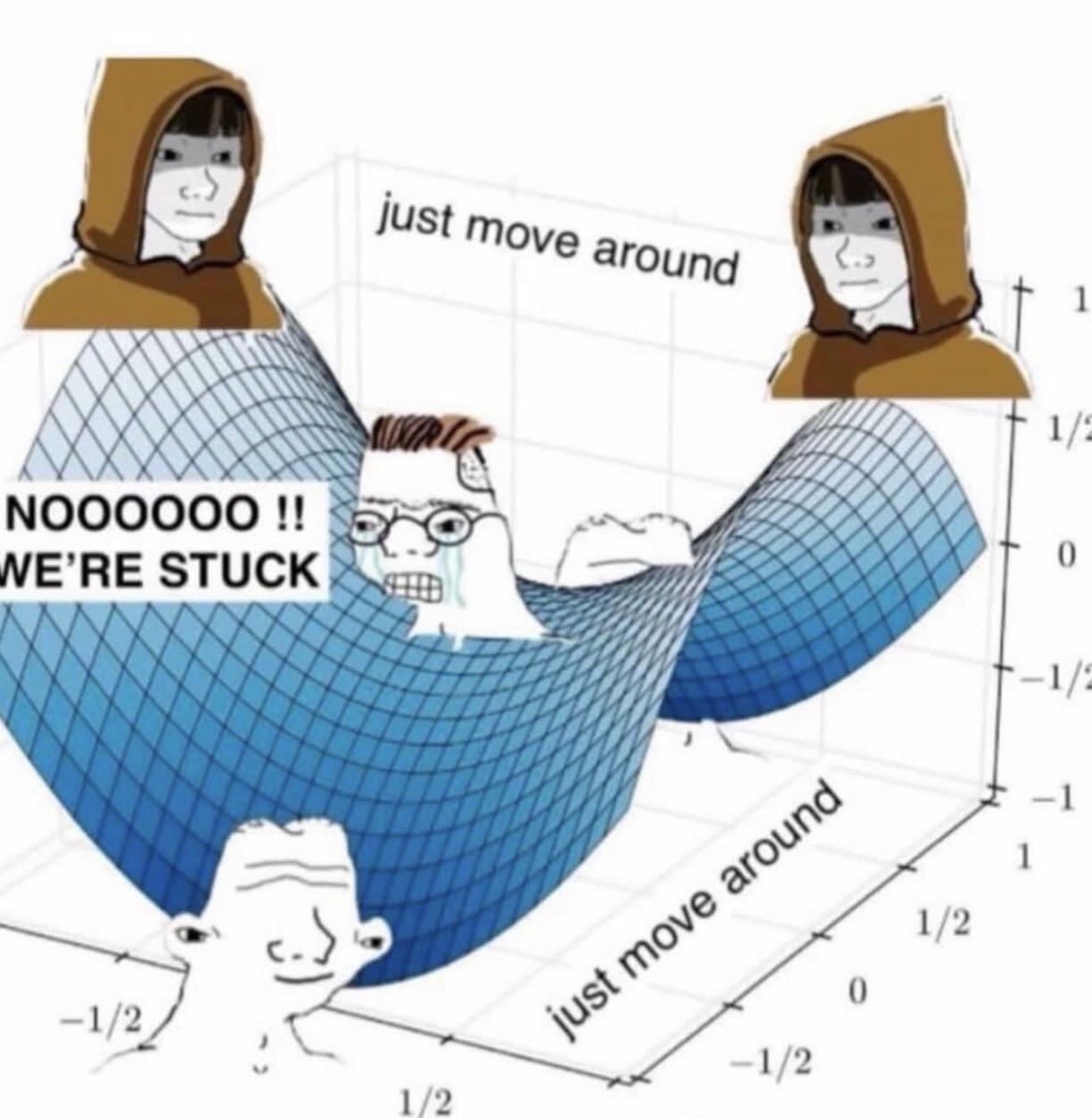
Saddle point meme — agents stuck in local minimum
Solutions

Strange Attractors

addresses → Temporal Mismatch
Lorenz attractor — deterministic chaos
Design principle from dynamical systems

Instead of specifying exact agent behavior (brittle), define the attractor basin — the set of acceptable states. Agents self-organize toward coherent behavior without centralized control.

  • No rigid plans — attractors emerge from simple rules interacting
  • Robust to perturbation — push the system, it returns to the basin
  • Sensitive to initial conditions — the butterfly effect is a feature for exploration
trophic levels — energy flows up, niches separate within each level
Solutions

Evolutionary Niches

addresses → Resources & Routing

Competitive exclusion (Gause, 1934): two species competing for the exact same niche cannot coexist. One will outcompete the other.

If you deploy two agents with overlapping capabilities, they will compete. The solution is niche differentiation.

  • Resource partitioning: Agent A handles files; Agent B handles APIs.
  • Temporal partitioning: Agent A plans; Agent B executes.
  • Character displacement: Similar agents should diverge when deployed together.
Solutions

Stigmergy

addresses → Brittle Harness
pheromone landscape — foragers follow trails · explorers (red) chart dark regions · gold = returning with resources
From swarm intelligence

Ants find the shortest path not by mapping terrain, but by leaving pheromone traces. Bad paths fade. Good paths get reinforced. Coordination through environmental signals.

  • Test results as fitness signals
  • Git history as a trail of decisions
  • Workspace as terrain — each agent's output reshapes the environment for the next
Solutions

Meta-Maps Through Concept Space

this presentation as a navigable concept space — problems attract, solutions bridge

Problems on the left, solutions on the right. Recursion terminates not by depth but by fitness. The presentation is the navigable system it describes.

The MetaMedium Principle

Not duplication but endless mappings. The same data — seen differently. A gesture draws a new view. A name creates a new lens.

No-Mode

Context determines action. The tool is the gesture, not a menu.

Composable

Simple things combine into complex things. Named compositions become building blocks.

Queryable

Everything is connected, searchable, meaningful. Ask the system about itself.

The vocabulary exists. The patterns work. So why aren't today's tools using them?

IV. Ecosystem Visualization

The Learning Loop

I
Wisdom
I know
Knowledge
I understand
Data
I perceive
Info
I process
DOUBT
SYNTHESIS
I — a strange looping black hole

Each turn isn't repetition — it's recursion. "I am learning that I am learning" has unbounded depth. The agent IS the loop.

wavelet corkscrew — DIKW cycle recedes into depth, each loop a learning pass
IV. Ecosystem Visualization

Recursive Representations

click children to zoom in — each level stays visible, building a hive · right-click to zoom out

Zoom is semantic

Each level reveals structure, not just bigger pixels.

The representation runs

A live simulation, not a static diagram. Agents are visible.

Self-description

The system visualizes itself using the same structures it operates with.

This presentation is itself a navigable concept space — an ecosystem of prose describing an ecosystem of prose.

The CS primitives already exist: recursion, delta encoding, grep, AST parsing, git history. The filesystem ships exact, instant, free affordances.

Ecosystem Viz

The Living Landscape

shifting fitness landscape · click to disrupt · trails show adaptation history
MacroGravity wells as resources. Dead zones = unexplored problem space.
MesoAgent clusters around peaks. Trails = stigmergic memory.
MicroToken flows as particles. File mutations as terrain. State as topography.

The ecosystem isn't a hierarchy you browse — it's a landscape you inhabit.

V. The Forest Floor

Down to the Valley

firefly synchronization — neighbors couple phases until they blink in unison

“The solution to agent orchestration is not a better harness.
It's a better habitat.”

the ecosystem is the interface

The Forest Floor

livingPROSE

spirals forage context → tools → memory → sub-query → output · watch particles emerge right
openProse = the ecosystem

The session is the runtime. The .prose program runs inside the agent.

RLM = the ratchet

Each pass carries forward compressed learning. Not retry — recursive self-modification.

Plants
publisher
Pollinators
pollinator
Predators
sentinel
Decomposers
gardener
Microbes
chronicler
Keystone
holon

We host the habitat. You own the organism.

The Forest Floor

The Living System

plants (green) · pollinators (gold) · predators (red) · decomposers (purple)
Plants

Interfaces. Resources in, outputs out. Roots = persistent state.

Pollinators

Message-passing agents. They connect the workers.

Predators

Selection pressure. Remove the redundant. Enforce quality.

Decomposers

Recycle spent context. Return resources to the soil.

Microbes

Logging, monitoring, heartbeats. Invisible, essential.

Keystone

The agent whose removal collapses the system. Protect it.

These roles aren't assigned — they're discovered. An organism finds its niche.